
Everything you need to know about payment processing
Navigate the complexities of payment processing with confidence. This guide demystifies the entire card payment journey from authorization to settlement, clarifying the distinct roles of acquirers, processors, and PSPs. This is for payments professionals looking to gain a clear mental model of how transactions move and learn how a modern, cloud-native acquiring processor like Silverflow can streamline your infrastructure to boost performance and control.
Everything you need to know about payment processing
Key insights:
Payment processing is everything that happens between "card accepted" and "money in the merchant's account," across authorization, clearing, settlement, and chargebacks. This guide focuses specifically on acquiring processing - the merchant and acquirer side of card payments. (Issuer processing, which handles the cardholder and issuing bank side, is a separate speciality.)
The acquirer is responsible for the merchant relationship, risk and settlement of funds, while the processor is the specialized engine that talks to networks so transactions flow correctly.
A modern, cloud‑native acquiring processor like Silverflow lets acquiring banks,
Payment companies and commerce platforms add capabilities such as network tokenization, SoftPOS and authorization optimization much faster than building direct card network connections themselves.
One well‑designed processing layer can support very different strategies: improving subscription approvals (Solidgate), enabling omnichannel (Buckaroo), accelerating launches in other geographies (payabl.), and delivering bank‑grade global acquiring for Deutsche Bank while enabling platform‑scale payments for Bolt.
In payments the difference is not made when everything goes according to plan. What matters is how you handle situations which did not go as expected, like un-authorized transactions, refunds, chargeback, reconciliation differences or compliance fees. This is where choosing the right partner matters.
This guide explains each step in plain English, clarifies the roles of acquirers, processors, PSPs and card networks, and shows exactly where a modern acquiring processor like Silverflow fits and helps improve the overall performance of the ecosystem.
Why is payment processing so confusing?
If your team can’t get through a single meeting without someone mixing up the acquirer, the processor, the gateway and “the networks,” you’re not alone. Acquiring and payment processing - the part of the card ecosystem that moves money from authorization to merchant settlement - is something everyone depends on and almost nobody explains clearly.
This page fixes that.
This is your Payment Processing 101: a living glossary and visual guide to how card payments actually move, from tap or click, to authorization, to money landing in a merchant’s account.
We’ll decode every key term in plain English, map out where acquirers, processors, PSPs, gateways and schemes sit in the stack, and highlight where an acquiring processor like Silverflow fits. Along the way, we’ll point you to short partner videos, like Solidgate on subscription performance or Buckaroo on omnichannel payments processing, so you can see how these concepts translate into effective and performing solutions.
By the end, your product managers, heads of Payments, and commercial teams will be using the same vocabulary in internal decks, vendor conversations, and roadmaps. You don’t need to be an engineer to follow along, but if you are one, we promise not to insult your intelligence.
(And yes, there will be diagrams.)
What is payment processing? (and why we focus on acquiring)
Payment processing is the set of behind‑the‑scenes steps that move a card transaction from "approved on screen" to "settled in the merchant's bank account," while the card networks and banks check that the card is valid, the customer has funds, and everyone gets paid correctly.
Card payment processing happens on two sides: the acquiring side (merchant -> acquirer -> schemes) and the issuing side (cardholder -> issuing bank -> schemes). This guide focuses on acquiring processing, which is Silverflow's speciality.
It covers how transaction data is captured, routed, authorized, cleared, and settled between the merchant, the card networks, the issuing bank, and the merchant’s acquirer across credit, debit, and prepaid card transactions, as shown in this ‘cast of characters’ diagram below…
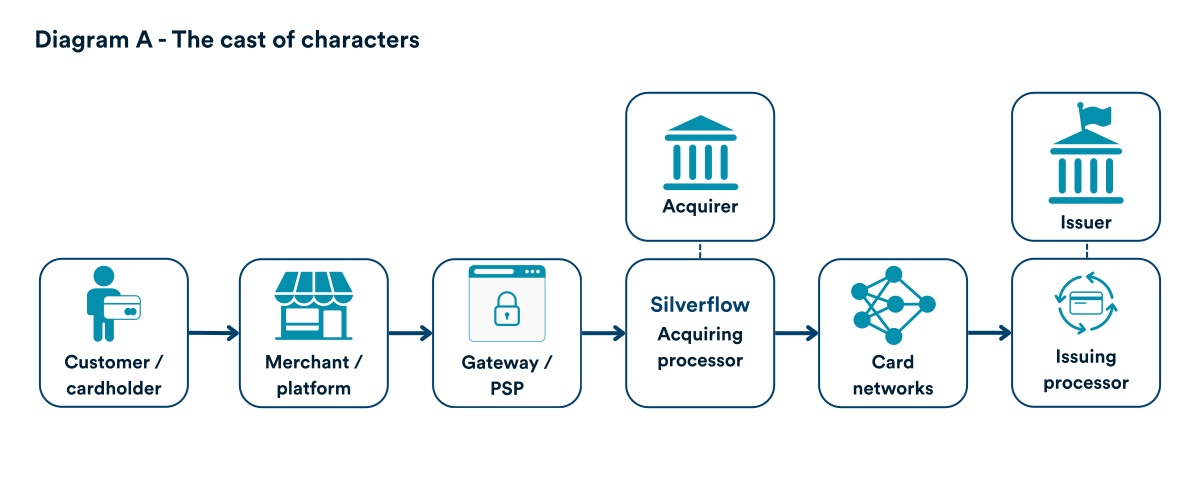
A processor handles each step of the technical conversation between the merchant side and the card networks, translating every message into the exact format the schemes and issuers require. That includes the real‑time authorization request (i.e. “can this cardholder pay 40 EUR right now?”) and the later clearing and settlement messages that actually move the money.
So, what does that actually mean, then?
In practice, that means an acquiring processor runs the infrastructure that sends messages like "authorize this 40 EUR card payment" from the merchant's front end to the card networks and issuers, and then returns the “approved” or “declined” response in a few hundred milliseconds. On the back end, the same processor helps generate the clearing and settlement instructions so the funds move on schedule and the merchant gets paid on the agreed payout day.
For acquiring banks, payment companies and commerce platforms, the acquiring processor is the technical engine under the hood: it talks to the schemes on the acquirer side, implements card rules, calculates scheme fees, and makes sure each authorization and settlement message is in exactly the right format.
"In the same way Buckaroo used Silverflow to quickly launch SoftPOS and unify in‑store and online processing, many providers rely on a specialist acquiring processor so they don’t have to build and maintain all that scheme connectivity themselves."
- Robert Kraal, Co-Founder, Business Development at Silverflow.

Some companies bundle acquiring, gateway and processing into one product; others, like Silverflow, specialize in acquiring processing and plug into acquiring banks, payment companies and commerce platforms that own the merchant relationship, or in the case of commerce platforms like Bolt, are the merchant themselves That’s how partners like Solidgate, xpate, Buckaroo, payabl., Deutsche Bank and Bolt can all use the same cloud‑native processing layer in very different ways - subscriptions at scale, omnichannel, replacing a legacy switch, or going direct‑to‑scheme for better control and more data.
For some helpful examples of this in action, take a look at our videos that show how different partners use the same processing layer in very different ways…
Watch: Solidgate x Silverflow on how modern processing lifted subscription approval rates.
Watch: Deutsche Bank x Silverflow on rebuilding global acquiring on a new processing stack.
How does payment processing work?
At a high level, every card payment goes through five main stages: authentication (verifying the cardholder's identity, especially in e-commerce), authorization, clearing, settlement, and (sometimes) chargebacks.
You can think of this less as “one magic payment event” and more as a short series of carefully choreographed steps…
1. Authentication - proving who you say you are
Authentication happens before authorization, especially in card-not-present (e-commerce) transactions. This is where Strong Customer Authentication (SCA) and 3D Secure (3DS) come in - the cardholder proves their identity through a password, biometric, or one-time code sent to their phone. In many regions, including Europe under PSD2, authentication is mandatory for online card payments to reduce fraud. Once the customer is authenticated, the authorization request proceeds.
2. Authorization - the instant yes or no
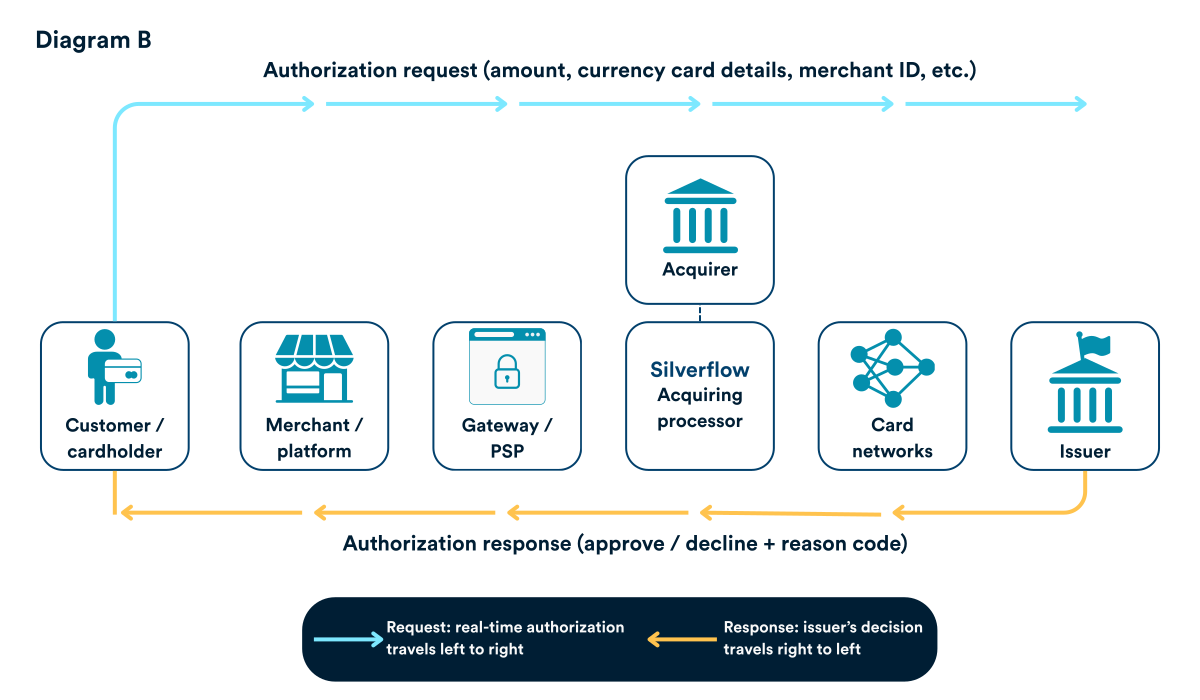
Authorization is the real‑time check that happens when a customer taps, dips, or types their card.
The customer initiates a payment at the merchant (online checkout, POS terminal, SoftPOS, in‑app).
The merchant or gateway sends a transaction request (amount, currency, merchant ID, card details, etc.) to the acquirer or PSP.
The acquirer’s processor formats and forwards that request through the card scheme (Visa, Mastercard, etc.) to the issuing bank.
The issuer approves or declines based on fund availability, risk rules and card status, and returns the response back through the same path.
The amount is reserved on the cardholders account to also ensure that funds stay available for this transaction.
In the same way Solidgate used network tokenization to lift initial approval rates for subscriptions, the details of how you route and format that authorization can have a big impact on whether you get a “yes” or a “no.”
You can see how that real‑time request and response travels through each party in the authorization flow in the diagram below, with Silverflow’s role in the chain highlighted…
3. Clearing: lining everything up
A common misconception is that a successful authorization is the same as getting paid, however that’s not strictly true. After the immediate “yes,” transactions move into clearing, where acquirers, processors and schemes make sure all the details line up.
Authorized transactions are batched up, usually by acquirer and scheme.
The acquirer’s processor compiles and formats clearing messages with transaction details, fees and any adjustments.
Card schemes receive these batches, validate them against network rules, and pass them along to issuers.
You can think of clearing as reconciling the “promise” made at authorization with the ledger entries needed to move funds and calculate fees. This is also where good card network‑level data and transparent fee calculations, (evidenced here in our partnership with Buckaroo), make operations and finance much less painful.
4. Settlement: moving the money
Settlement is when the money actually moves from the cardholder’s bank to the merchant’s bank.
After clearing, issuers transfer the net amounts (after interchange and other fees) to the card networks.
The networks forward those funds to the acquirers.
The acquirers pay out merchants according to their funding schedules, usually minus acquirer and processing fees.
Different acquirers and processors offer different settlement timelines and levels of control. In the same way Deutsche Bank is using Silverflow’s stack to build a unified global acquiring platform, many institutions want consistent settlement rules and reporting across regions rather than a patchwork of local setups.
5. Chargebacks and disputes, aka: ‘running payments in reverse’
Sometimes customers dispute transactions. That’s where chargebacks and dispute flows come in.
A cardholder disputes a charge with their issuer (fraud, goods not received, etc.).
The issuer raises a chargeback through the network to the acquirer, who passes it to the merchant.
The merchant can accept the chargeback or fight it with evidence; if they lose, the funds are reversed and extra fees may apply.
“From a processing perspective, the key is that chargebacks and representments follow defined, scheme‑specific rules and timelines. That’s why partners like Buckaroo and others value having dispute tooling built into the processing layer instead of bolted on as an afterthought.”
- Robert Kraal, Co-Founder, Business Development at Silverflow.
The card payment process, step by step
Now that you’ve seen what payment processing is and how authorization, clearing and settlement fit together, it’s useful to look at the whole journey end‑to‑end, from the moment the customer pays to the moment the merchant sees the funds.
The diagram below walks through that flow step by step, with Silverflow’s role as the acquiring processor highlighted in the middle…
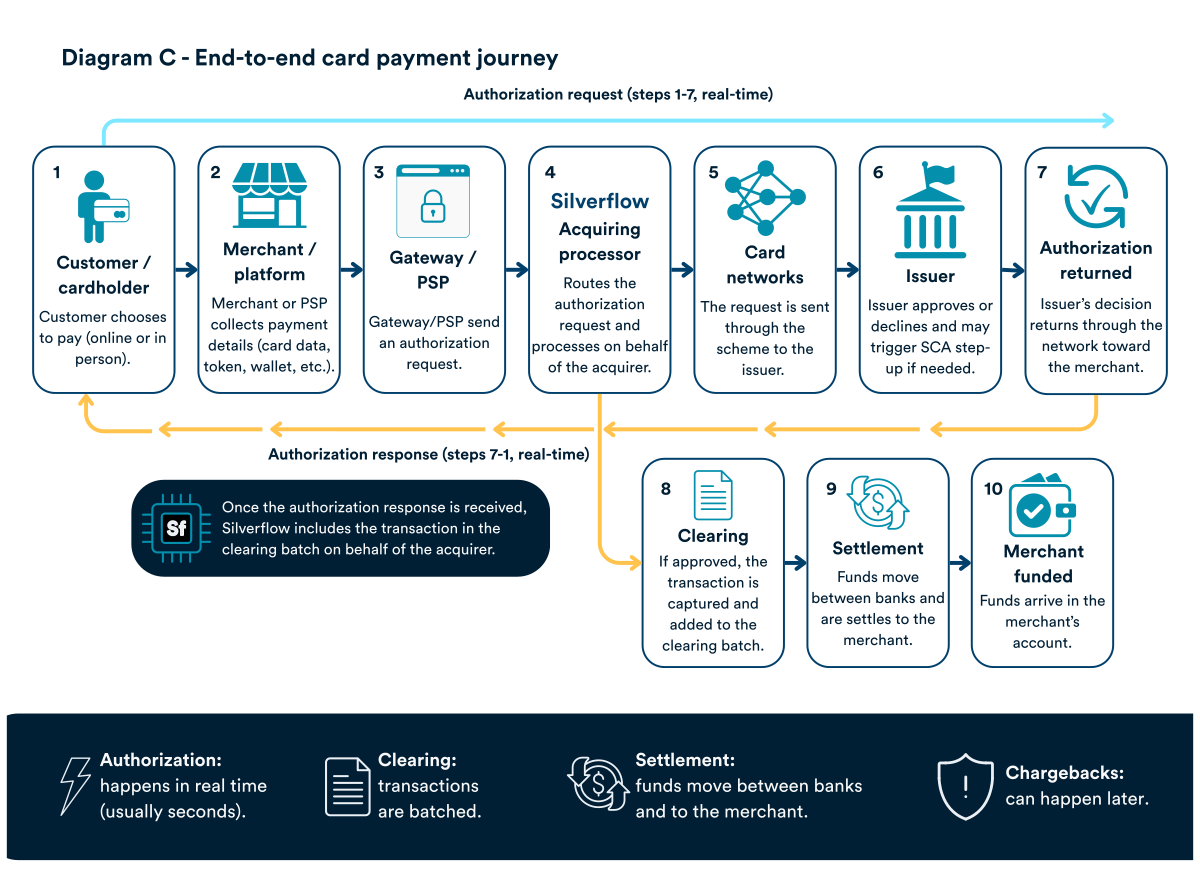
Here’s a helpful step-by-step guide to help explain the card payment process further…
The cardholder chooses to pay
The customer starts the payment, either online or in person.Payment details are collected
The merchant, platform or PSP collects the relevant payment details, such as card data, tokenized card details or wallet information.The authorization request is sent
The gateway or PSP sends the authorization request into the payment chain.Silverflow processes the request on behalf of the acquirer
As the acquiring processor, Silverflow routes and formats the authorization request so it can be passed through the right card network to the issuer.The card network passes the request to the issuer
The card network sends the request to the issuing bank for a decision.The issuer approves or declines the transaction
The issuer checks the transaction and returns an approval or decline. In some cases, additional checks such as SCA step-up may be triggered.The authorization response travels back
The issuer’s decision moves back through the card network, Silverflow, gateway/PSP and merchant, completing the real-time authorization flow.Silverflow includes the transaction in the clearing batch
Once the authorization response has been received, Silverflow includes the approved transaction in the clearing batch on behalf of the acquirer.Clearing and settlement take place
The approved transaction is processed through clearing, then funds move between the relevant parties during settlement.The merchant is funded
Funds arrive in the merchant’s account, minus any applicable fees.
If something goes wrong later, chargebacks or dispute flows can still reverse part or all of the transaction.
“In the same way Bolt is simplifying its own payment stack by going direct to the card networks through Silverflow, many high‑volume platforms want to shorten this chain, fewer hops, more control, the same fundamental steps.”
- Robert Kraal, Co-Founder, Business Development at Silverflow.
Merchant acquirer vs payment processor
“Merchant acquirer vs payment processor” is one of the most common (and most important) questions in payments. The two roles work closely together but they’re not the same thing.
What is a merchant acquirer?
A merchant acquirer (or acquiring bank) is the licensed financial institution that:
Holds a banking license or payment institution license (depending on jurisdiction) to operate as an acquirer.
Provides merchants a solution that allows businesses to accept card payments.
Takes on financial risk for fraud and chargebacks.
Facilitates authentication, authorization and settlement with issuing banks via the card network.
Controls settlement schedules and, often, pricing models for merchants.
In the same way Deutsche Bank built a new acquiring platform on top of Silverflow, many acquirers are responsible for the commercial and regulatory side while delegating the heavy technical processing work to a specialist.
What is a payment processor?
Believe it or not, "payment processing" and "payment processor" are not the same thing. Payment processing is the whole journey from authorization through clearing, settlement and chargebacks; an acquiring processor is the specialist technology provider that runs that journey on the acquiring side on behalf of acquirers, PSPs and platforms.
A payment processor typically:
Securely transmits transaction data from merchants and acquirers to schemes and issuers.
Handles real‑time authorization and message formatting.
Manages clearing and supports settlement operations.
Provides tools for reporting, reconciliation, and chargebacks.
Some acquirers run their own processing stack; others, like many Silverflow partners, use a third‑party acquiring processor so they can move faster, modernize their stack, and access features such as network tokenization and SoftPOS without building everything in‑house.
Payment processor vs merchant acquirer (and where PSPs fit)
From a merchant’s perspective, it’s no surprise processor and acquirer often blur together. Both are essential to accepting cards, and both might appear in contractual documents or monthly statements.
In the same way xpate talks about compressing “time to money” for merchants, you can think of acquirers and processors as two halves of the journey. The acquirer is responsible for the money and bears liability for the merchant; the processor is responsible for the technical integrations in the ecosystem that make that money move.
Where PSPs, gateways and platforms sit
On top of acquirers and processors, you often have:
Payment service providers (PSPs) / gateways: Provide checkout pages, tokenization, routing rules and merchant dashboards, usually sitting between the merchant and one or more acquirers. They also typically offer other (non-card-based) payment methods.
Payment facilitators / platforms: Aggregate many sub‑merchants under a master account, handle onboarding and risk, and often integrate to one or more underlying acquirers and processors.
xpate, Buckaroo, payabl. and Bolt all operate in this space: they own the merchant relationship and product experience, but rely on a specialist acquiring processor like Silverflow for scheme connectivity and deep card processing logic.
Where acquiring processing fits (and why Silverflow specialized here)
Acquiring processing focuses specifically on the acquirer‑to‑card network side of the payment flow for cards. It includes:
Connecting to card networks (Visa, Mastercard and others) and speaking their protocols.
Handling card‑present and card‑not‑present transactions for acquirers and PSPs.
Implementing network tokenization, recurring payment logic and account updater flows.
Calculating and exposing scheme and interchange fees.
Providing tools for chargebacks, reconciliation and card network‑level reporting.
“We chose to specialize in acquiring processing because this is where most of the hidden complexity, performance impact and regulatory change actually sit. Rather than spread ourselves across gateways, UX and issuing, we focus on building one cloud‑native, API‑first processing layer that acquirers, PSPs and platforms can all plug into.
That’s why Solidgate uses us to power subscription performance, Buckaroo uses us for omnichannel, payabl. for a modern switch, Deutsche Bank for global acquiring, and Bolt for direct‑to‑scheme control - very different strategies, all built on the same modern acquiring processing platform under the hood”
- Robert Kraal, Co-Founder, Business Development, Silverflow.
To make the split between merchant/PSP, acquirer and acquiring processor even clearer, the diagram below stacks these three layers on top of each other and shows who owns customer experience, who owns commercial risk, and where our processing platform does the heavy lifting…
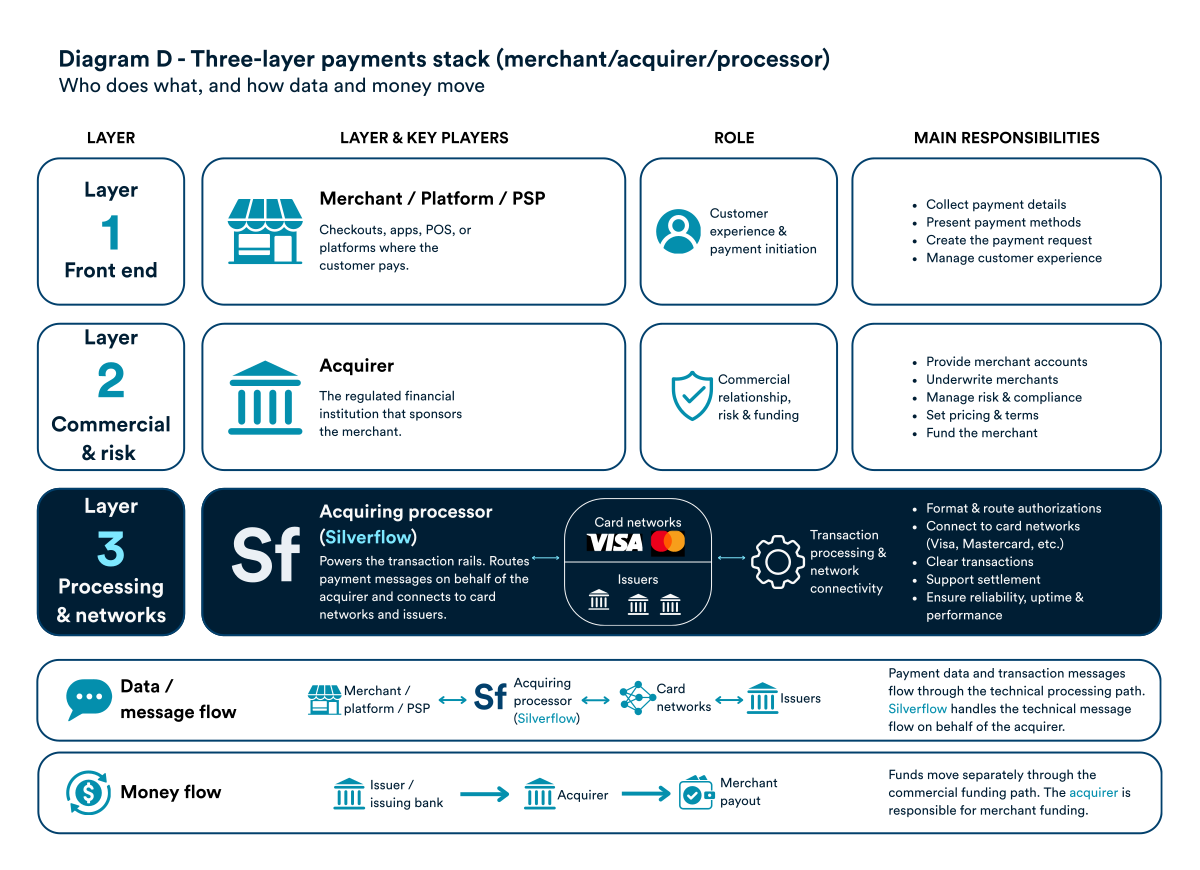
Now you've seen the whole picture...
…from who the acquirer is, to what the processor does, to how card networks and issuers fit in, it gets much easier to spot where your own stack is helping or holding you back.
Our goal with this guide is to give your teams a shared language and a clear mental model, so the next time you discuss network tokenization, omnichannel, or “switching out the legacy processor,” you’re all looking at the same map, and can decide, together, where a modern acquiring processor like Silverflow should sit in your architecture and roadmap.
If you’re rethinking how your acquiring and processing should work, let’s talk.
Share your current setup with us and we’ll map how a cloud‑native acquiring processor like Silverflow could simplify your stack, improve performance, and get new products and features to market faster.
Glossary: key payment processing and acquiring terms
New to payments, or just need a refresher? This list of payment-specific terms might help…
Acquirer / merchant acquirer: The licensed financial institution that provides merchant accounts, takes on chargeback and fraud risk, and facilitates authorization and settlement for card payments.
Acquiring processing: The technical processing of card transactions on behalf of acquirers and PSPs, covering scheme connectivity, authentication, authorization messaging, clearing, settlement support, fee calculation and chargeback tooling.
Authorization: The real‑time decision step where the issuer approves or declines a transaction request before any funds move.
Clearing: The post‑authorization step where transaction details are batched, validated and reconciled between acquirers, networks and issuers to prepare for settlement.
Settlement: The movement of funds from the cardholder’s bank to the merchant’s bank, usually via the card networks and the acquirer, after fees are applied.
Chargeback: A rules‑based dispute process where a transaction is reversed and funds are returned to the cardholder after a successful dispute.
Gateway: The service that securely captures payment details from the customer and forwards transaction requests to one or more acquirers or processors.
Payment processor: The technology provider that moves transaction data between merchants, acquirers, networks and issuers, handling authentication, authorization and clearing messaging.
PSP (payment service provider): A company that offers merchants a packaged way to accept payments, often combining gateway, routing, risk and integration to one or more acquirers and processors.
Card networks: Networks such as Visa, Mastercard, and others that define rules, provide routing, and move funds between issuers and acquirers.
Issuer / issuing bank: The bank or financial institution that provides payment cards to consumers or businesses and pays the merchant’s acquirer when card transactions are approved.
Network tokenization: A card‑network provided mechanism that replaces card numbers with secure tokens which update automatically, improving approval rates and reducing friction for recurring and stored‑card payments.
SoftPOS: “Software point of sale” that turns an NFC‑enabled smartphone or tablet into a contactless payment terminal without extra hardware.
TL;DR:
Payment processing is everything between "card accepted" and "money in your account" - authorization, clearing, settlement, and chargebacks flowing through acquirers, processors, card networks, and issuers. A modern cloud-native acquiring processor like Silverflow handles the scheme connectivity and card network complexity on the merchant and acquirer side so you can focus on merchant experience, not infrastructure.
By Anne Willem de Vries, Co-founder & CEO
Read also

Silverflow expands US team as it targets further growth in North America
The move forms part of Silverflow’s wider international growth strategy, with North America a key market for expansion.

Silverflow & Solidgate: Reducing False Declines with Real-Time Data
Discover how real-time payment data helps reduce false declines, improve approval rates, and protect recurring revenue for subscription businesses. In...

Silverflow and Hypergate launch integrated payment solution to accelerate acquiring innovation
Silveflow and Hypergate's joint solution enables acquirers and payment providers to accelerate onboarding, reduce operational complexity and modernise payment infrastructure.